
Tea and the American Revolution
Boston and Britain’s American colonies, 1767–1776
The story now steps back, to the decades before Assam’s gardens. From the 1760s Parliament sought to raise revenue from its American colonies, which objected to taxes set by a Parliament in which they had no representatives. In 1767 the Townshend duties taxed several imports, tea among them. In 1770 most were repealed, but the duty on tea was kept, to assert Parliament’s right to tax the colonies.
In 1773 Parliament passed the Tea Act to help the East India Company, which was in financial trouble and held a large stock of unsold tea. The Act let the Company sell tea in the colonies through chosen merchants, the consignees, at a price low enough to undercut smuggled tea. The duty still applied.
The colonists’ objection was to the principle more than the price: to pay the duty was to accept Parliament’s right to tax them. The Act also threatened the merchants who imported tea legally and those who smuggled it, and it gave the Company a privileged place in the colonial market.
At Boston, Governor Thomas Hutchinson would not let the tea ships leave until the duty was paid. On the night of 16 December 1773, men disguised as Mohawks boarded the ships and threw more than 340 chests of the Company’s tea into the harbor.
Parliament responded in 1774 with the Coercive Acts, which closed the port of Boston and curtailed Massachusetts’ self-government; the colonists called them the Intolerable Acts. Delegates from twelve colonies met as the First Continental Congress and agreed to boycott British goods, British tea among them, and many colonists pledged to stop drinking it. In April 1775 fighting began at Lexington and Concord. On 4 July 1776 Congress adopted the Declaration of Independence.
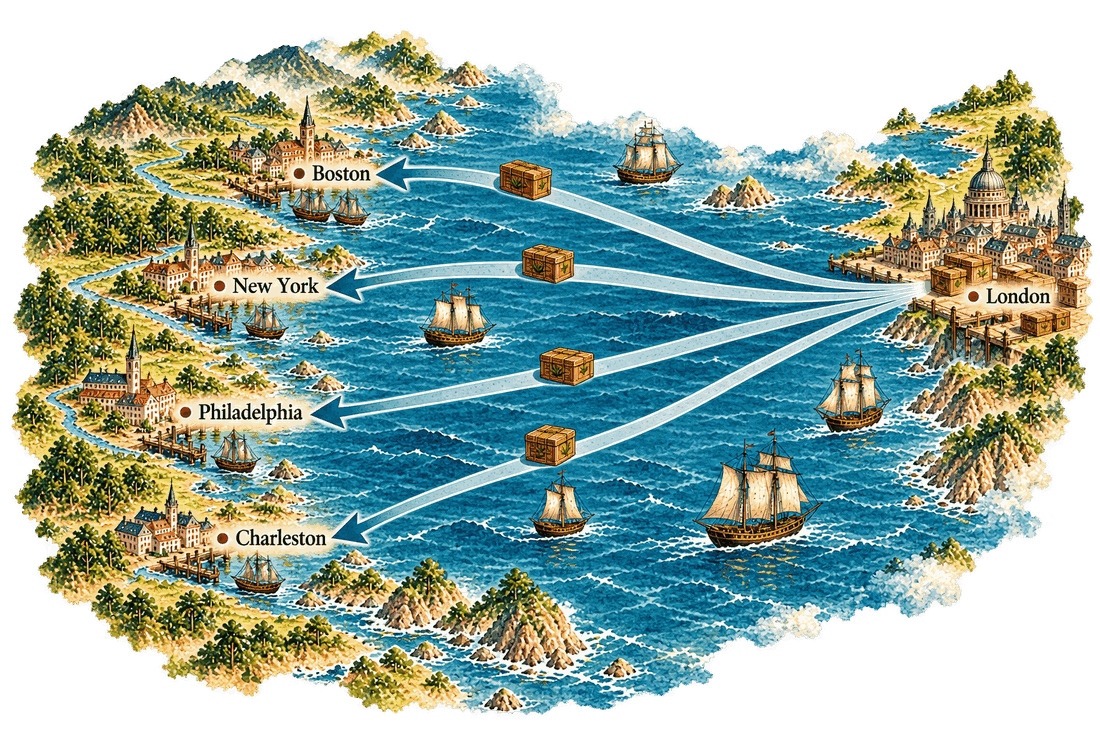
In 1773 the Company’s tea was sent to four colonial ports: Boston, New York, Philadelphia and Charleston.
Four Ports
The Company’s tea went to four ports, and each answered differently. At Philadelphia and New York the consignees resigned and the ships returned to England with their cargo. At Charleston the tea was landed, but no one would take delivery of it. Only at Boston did the governor refuse to let the ships leave.

Principle, Not Price
Legal tea was cheaper; the colonists objected to the duty it carried.
A Company’s Rescue
The Tea Act was passed to help the East India Company sell its unsold tea.
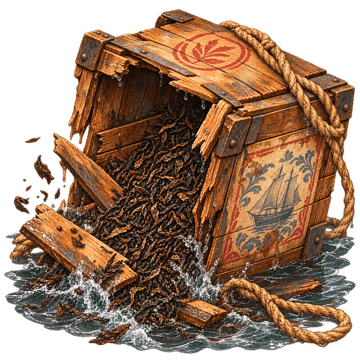
Boston Destroyed the Tea
On 16 December 1773 more than 340 chests went into the harbor.

The Crisis Escalated
The Coercive Acts came in 1774; fighting began at Lexington and Concord in 1775.

Britain made tea cheaper in America,
but could not make the colonists accept the tax.
The tea thrown into Boston Harbor belonged to the East India Company.
What became of tea in Britain itself, as industry remade its towns?
Next · Chapter EightTea and Industrial Society