
The Silk Roads
From the Han to the Tang, second century BCE–ninth century CE
By the Tang dynasty (618–907), tea in China was commonly pressed into cakes. West of China ran the trade routes that had carried silk since the Han dynasty opened them in the second century BCE. In time, tea traveled on them too, as one good among many.
The earliest physical evidence of that journey comes from the Tibetan Plateau. In a tomb in Ngari, in western Tibet, some 4,300 meters above sea level, archaeologists found tea about 1,800 years old. Its chemistry matches tea from Yunnan, and it is some four to five centuries older than the first written record of tea in Tibet. It suggests that a branch of the Silk Road crossed the plateau by the second or third century CE.
The first people beyond China known to have traded for tea in quantity were the Uighurs, whose khaganate ruled the steppe north of China from 744 to 840. The New Tang History records that they began to buy tea with the horses they drove into China, in the time of Lu Yu, who died in 804.
Word of tea traveled farther than the leaf itself. An Arabic account of India and China, based on a merchant named Sulayman who is said to have traveled there in 851–852, describes a plant the Chinese drink with hot water, sold in every city, its trade controlled by the ruler. It is the first known description of tea from outside China, written some seven centuries before Europe’s.
Knowing of tea was not the same as drinking it. In Persia, the habit of drinking tea did not take hold before the thirteenth century, and coffee remained the common drink there until the nineteenth.
So in these centuries tea moved west slowly, and only part of the way: drunk on the steppe, described in an Arabic account, but still largely a Chinese good. Closer to its source, another route was developing around the trade in tea and horses.
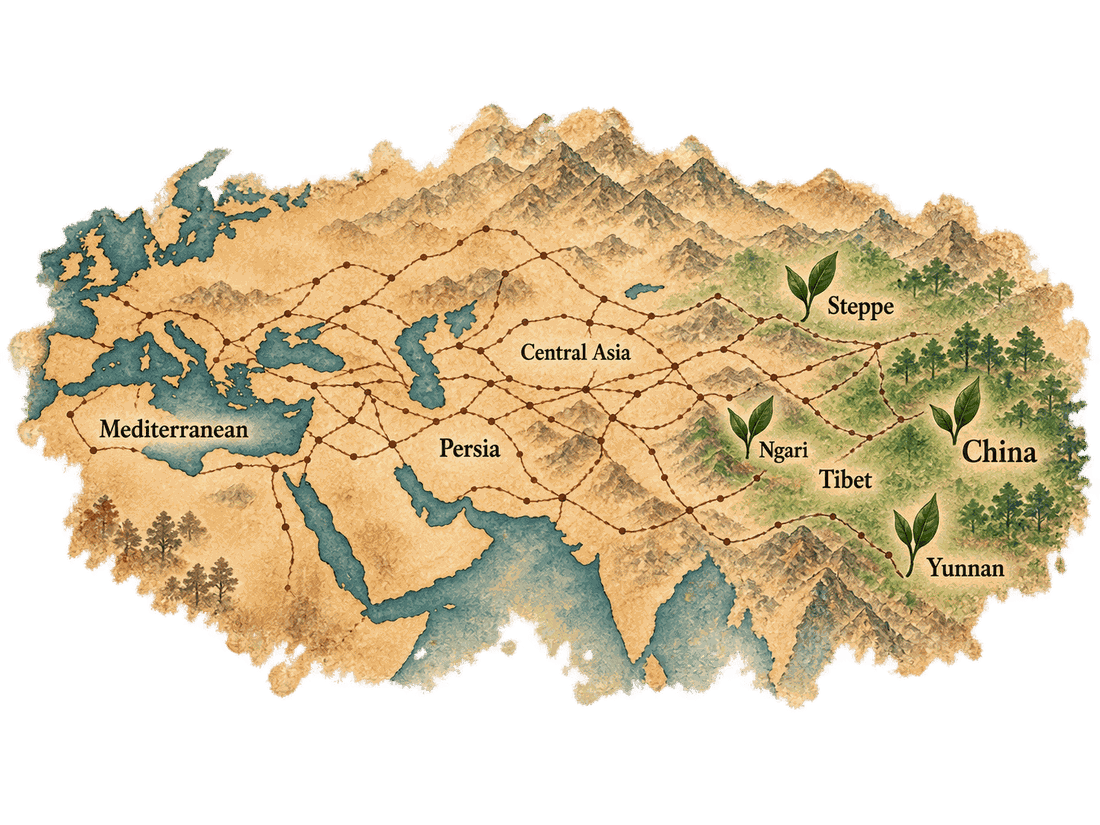
The routes reached the Mediterranean; tea, in these centuries, went only part of the way.
The Road That Was Never One Road
The traders who used these routes never called them the Silk Roads. The name came much later. In 1877 the German geographer Ferdinand von Richthofen used Seidenstraße and Seidenstraßen — “Silk Road” and “Silk Roads” — for trade routes that were already around two thousand years old. Under the Han dynasty, Emperor Wu had sent Zhang Qian west in 138 BCE; the routes that developed through Central Asia helped connect China, through Persia, with the Mediterranean world.
What we now call the Silk Roads is therefore a later name for a changing network, not a single ancient highway.
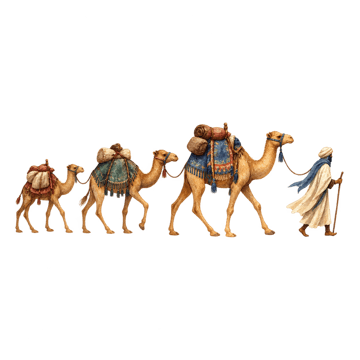
Movement Was Gradual
Tea did not sweep west along a single route. Its spread took centuries.
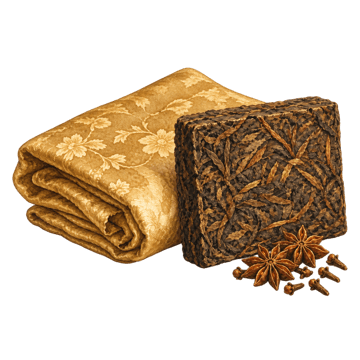
Trade Came Before Adoption
A commodity can reach a market long before it becomes part of everyday culture.

Exchange Changed Value
On the steppe, tea became valuable enough to exchange for horses.
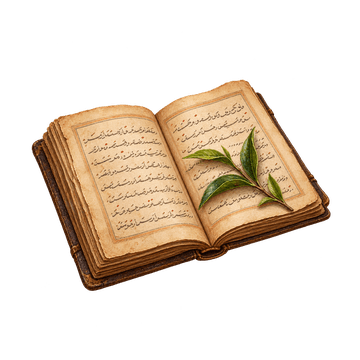
Information Traveled Too
By the ninth century, people far beyond China could describe tea even where drinking it was not yet common.
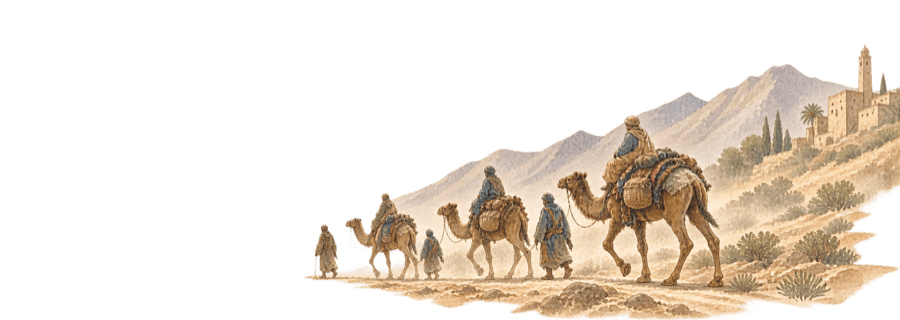
The trade routes carried tea west slowly,
from one market to another.
Tea about 1,800 years old, found in a tomb in western Tibet, matches tea grown in Yunnan.
If tea could travel this far as one good among many, what happens when a whole trade is built around it?
Next · Chapter TwoThe Tea Horse Road