The First Journey
From Tang China to Japan’s way of tea
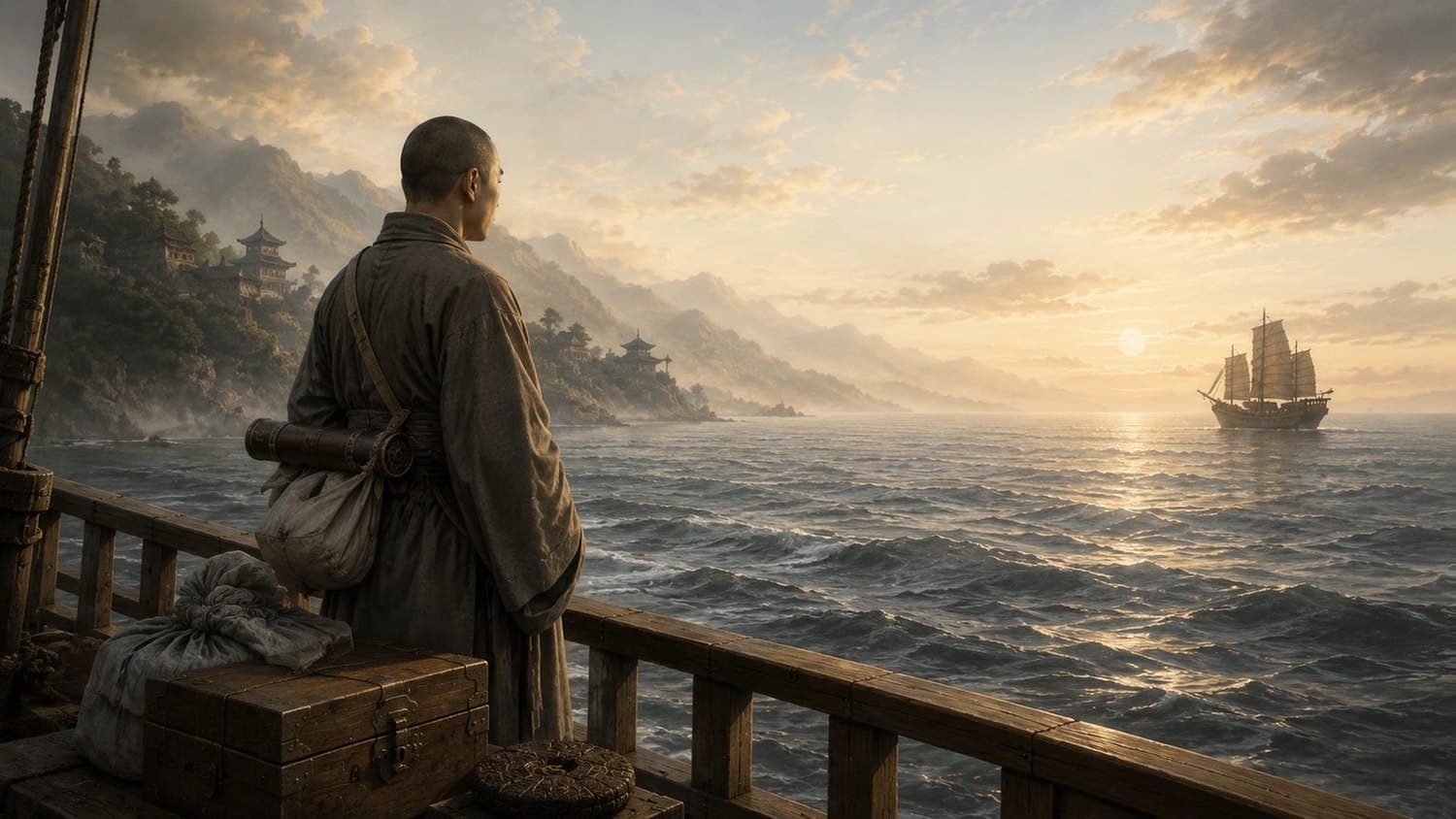
Japan sent official missions across the sea to Chang’an, the Tang capital, and with the envoys went student-monks who stayed on to study Buddhism. The crossing was long and dangerous, and some ships never arrived. The monks went for the teaching, but in the monasteries where they studied, tea was part of daily life.
When they came home, some brought tea with them. The best known are two monks who sailed with the mission of 804: Saichō, who founded the Tendai school of Japanese Buddhism, and Kūkai, who founded the Shingon school. Kūkai’s writings of 814 mention that he drank tea in China. He and Saichō are thought to have brought back the first tea seeds to Japan, and Saichō is often credited with planting them, though the documentary evidence is uncertain.
The first reliable record comes from Japan’s court chronicle, the Nihon Kōki. In 815, Emperor Saga traveled to Karasaki, on the shore of Lake Biwa in Ōmi province. On the way he stopped at the Bonshakuji temple, where its senior monk, Eichū, who had studied in Tang China, served him tea he had brewed himself. A few months later, the emperor ordered tea to be grown near the capital. But after Saga’s reign, interest in Tang culture declined, and tea drinking declined with it.
Tea returned almost four centuries later. Around 1191, the monk Eisai, who also brought the Rinzai school of Zen to Japan, came home from Song China with tea seeds and a new way of drinking it. In Song China, tea leaves were ground to a fine powder and whisked with hot water in the bowl. That powdered tea, the ancestor of matcha, became an important part of life in Japan’s Zen monasteries, and Eisai wrote a book recommending tea for health. Seeds he gave the monk Myōe were planted at Toganoo, near Kyoto, and nearby Uji became Japan’s first great tea-growing region.
From the monasteries, tea spread to the warrior class. In the thirteenth century it was a status symbol, and contests called tōcha awarded prizes to whoever could identify the finest teas. In the fifteenth century, Murata Jukō, who studied Zen under the monk Ikkyū, began to turn tea into a spiritual practice.
The tradition took its lasting form in the sixteenth century. Sen no Rikyū (1522–1591), tea master to the warlord Toyotomi Hideyoshi, made wabi, the beauty of simple, unadorned things, the heart of tea. From his teacher Takeno Jōō he took ichi-go ichi-e, “one time, one meeting”: every gathering should be treasured, because it can never be repeated. In 1587 he helped Hideyoshi stage the Grand Kitano Tea Ceremony in Kyoto. Out of this grew the Japanese tea ceremony, which the Japanese call chanoyu, or sadō, “the way of tea”: an elaborate ritual with its own rules, guided by four principles: harmony, respect, purity and tranquility.
Every step of it is prescribed. The host cleans each utensil in front of the guests, in a set order, then scoops powdered tea from its caddy with a bamboo scoop, adds hot water and whisks it with a bamboo whisk. Host and guest bow to each other. The guest turns the bowl slightly so as not to drink from its front, drinks, and then the guests examine the bowl, the tea caddy and the scoop in turn. A full gathering, a chaji, can last up to four hours: it includes a formal meal, kaiseki, and a single bowl of thick tea, koicha, shared among all the guests, as well as the more familiar whisked thin tea, usucha. The hanging scroll, the flowers and even the designs on the bowls are chosen for the season.
The ceremony is still taught and practiced in Japan today. Students learn it from a teacher by watching and by practice, in schools such as the three Senke houses, which descend directly from Rikyū.
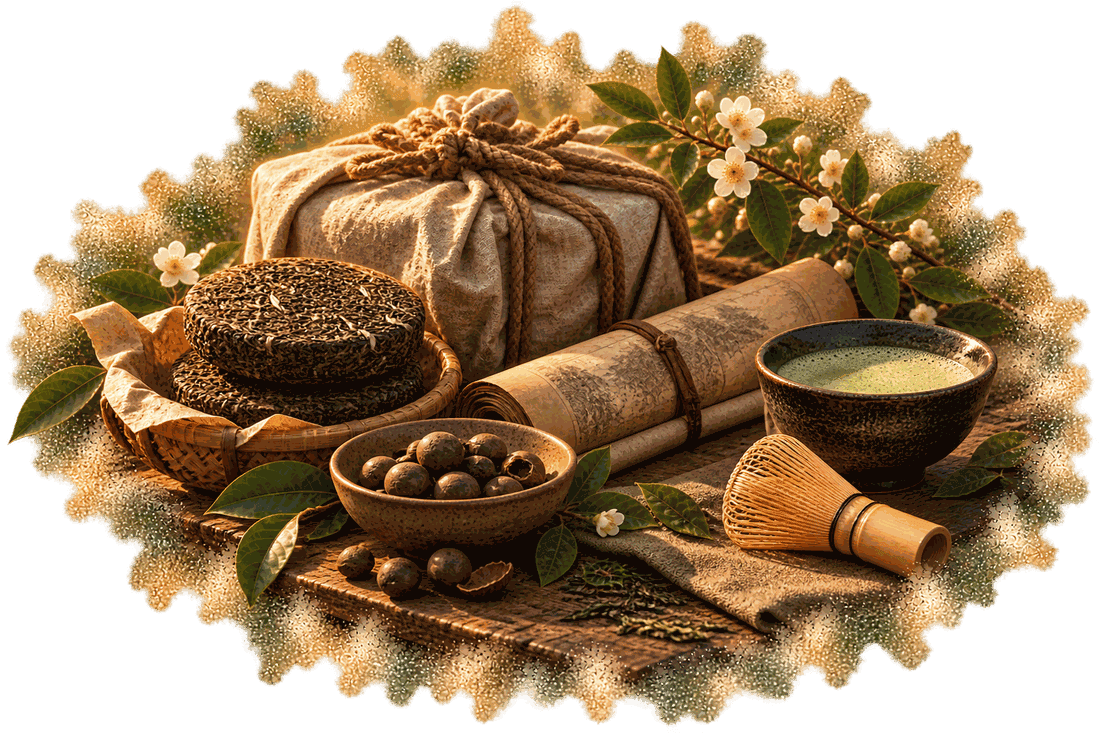
Tea crosses the sea to Japan.
Tea crosses the sea to Japan.
Tea reached Japan by sea, carried home by monks and envoys returning from years of study in China: a handful of seeds, a few pressed cakes, and the knowledge of how tea was made.
Over the centuries that followed, Japan made the leaf its own. Its most lasting form is a small, quiet room built for one purpose: preparing and sharing a bowl of tea.

Worth the Crossing
By the ninth century, tea was valued enough for monks to carry it across a dangerous sea.
Carried by Monks
Monks brought tea to Japan twice: in the Tang, and again with Zen and powdered tea in the Song.

Rooted in New Soil
From Toganoo and Uji, tea took root in Japan and became its own.

A Seed of What’s to Come
Powdered tea, the tea room and wabi became a tradition unique to Japan: the way of tea.
China gave tea its beginning.
Japan made it a way of its own.
Act One ends here, with tea’s first crossing and the tradition it grew into. Act Two follows the roads and ships that carried tea west, to the rest of the world.
At Camelia Lounge, we keep the lesson of the tea room: every gathering over a cup happens only once.
Where else would the leaf travel?
Next · Act TwoThe Journey