The Discipline of Tea
The Chan monasteries, from the Tang to the Song
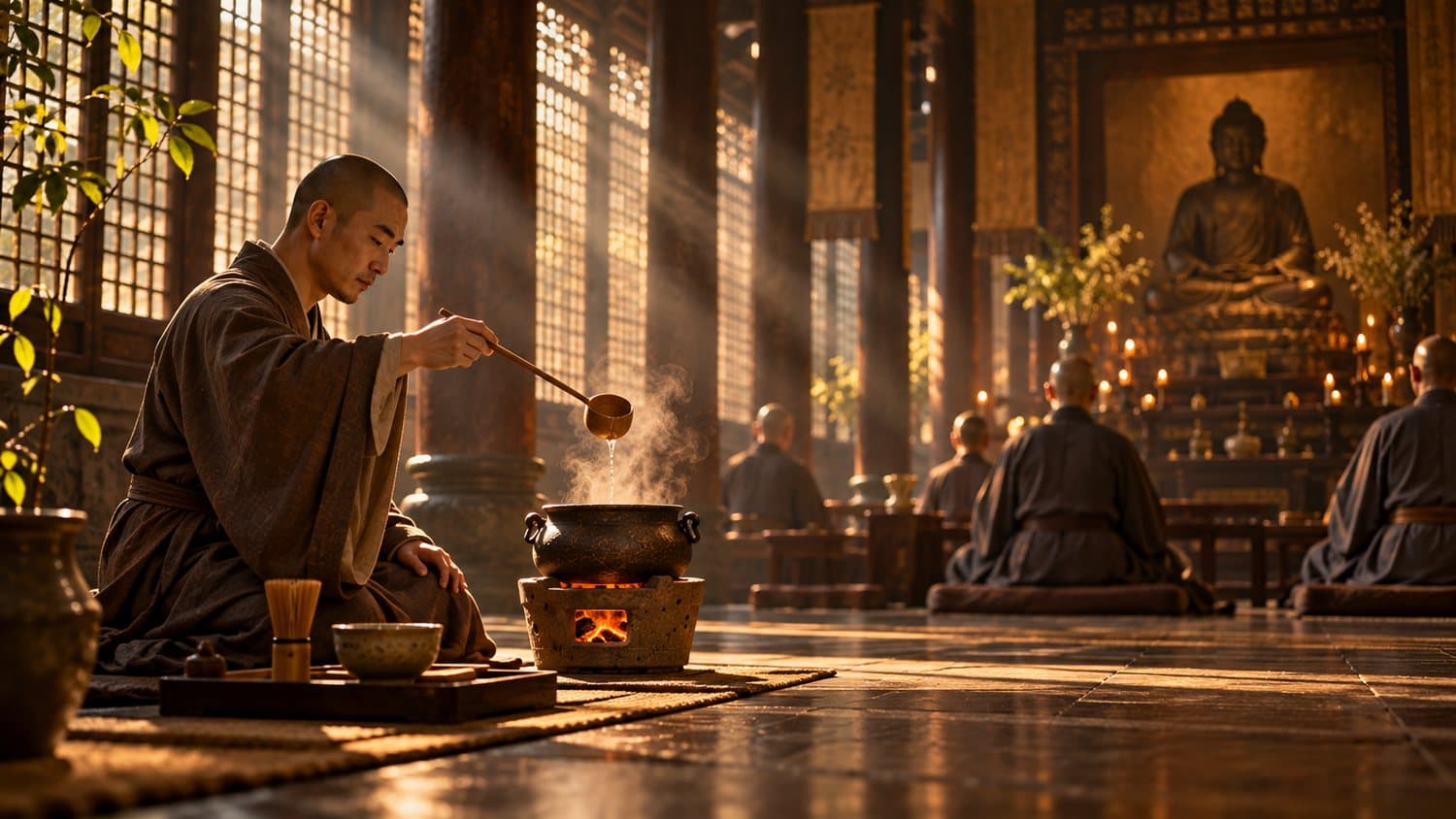
Chan, the school of Buddhism that placed seated meditation at its center, grew in China’s monasteries in the same centuries that tea spread across the empire. Monks drank no alcohol and ate no solid food after noon. Tea kept them awake and clear-headed through long hours of meditation, and it became part of the monastery’s daily life.
Chan tradition holds that the master Baizhang Huaihai (720–814) wrote the first rules for Chan monasteries, and it credits him with the saying “a day without work is a day without food.” No copy of his rules survives, however, and no source from his own time mentions them. Historians now treat the code as a later legend.
The oldest Chan code that does survive is the Chanyuan qinggui, the Rules of Purity for Chan Monasteries, compiled by the monk Changlu Zongze in 1103, under the Song dynasty. It governs almost every part of monastic life. Among its rules are detailed procedures for “tea services”: formal gatherings at which the abbot or senior monks served tea to the community, to newly arrived monks, and to visiting officials.
The rules fixed who invited whom, where each person sat, when incense was burned, and how the tea was offered and received. Serving tea kept relations good within the community and, at the same time, marked each monk’s rank. It was also one of the main ways a monastery welcomed a newcomer.
Tea services were held in several halls: the abbot’s quarters, the monks’ hall, the common quarters. A few great ones were fixed in the monastery’s yearly calendar. The “Holy Monk,” the image of a bodhisattva (usually Manjushri) enshrined in the monks’ hall, was included in the service, so that tea was offered to the sacred as well as to the community.
Some Chan teachers used tea in their teaching as well. In Zhaozhou’s story, one reply, “Go and have some tea,” answers every question. Chan readers have long taken it to mean: attend to what is in front of you.

A companion to the work of attention.
A companion to the work of attention.
In the monastery, tea served three purposes at once: it helped monks stay awake through meditation, it was offered in ritual, and it was served at formal gatherings that held the community together.
Modern accounts often go further and call Chan and tea “one taste.” Recent scholarship urges caution: much of that idea took shape in later writing, especially in modern Japan. What the monastic codes record is more concrete: a drink served by rule, in a set order, to everyone.

An Ally of Attention
Tea kept monks awake and clear-headed through long meditation, in place of any stronger drink.
From Method to Meaning
Lu Yu wrote how to make tea; the monasteries wrote rules for how to serve and receive it.
The Cup as Practice
Serving tea by rule, in a set order, became part of monastic discipline.
Carried Beyond the Cloister
Monks who came to study in China’s monasteries took these customs home with them.
Lu Yu taught how to make tea.
The monasteries taught how to share it.
China’s monasteries drew monks from abroad to study. When they sailed home, some took tea with them.
At Camelia Lounge, as in those monastery halls, a cup offered to a guest is the first gesture of welcome.
What carries a leaf across the sea?
Next · Chapter SixThe First Journey