
The Wild Leaf
Southwest China, before written history
The tea plant is native to the mountains where southwest China meets present-day Myanmar and northeast India. It has two main varieties: a small-leaved one, sinensis, long grown across China, and a large-leaved one, assamica, native to Yunnan and to Assam in India. Genetic studies suggest people domesticated the plant more than once, in China and separately in India. In Yunnan, on that frontier, it still grows as a tree. Left alone, it can stand many meters tall, and some of the region’s oldest tea trees are counted in centuries. The low bushes of a modern tea garden are the same species, pruned to keep the leaves within reach.
Who first used the leaf is not recorded. Historians think the peoples of these mountains chewed it, cooked it or ate it fermented long before anyone brewed it as a drink. The habit survives: in Myanmar, fermented tea leaves are still eaten today as lahpet.
The oldest physical evidence comes from much farther north. In 2021, archaeologists identified the charred remains of boiled tea leaves in a bowl buried in a Warring States tomb in Shandong, about 2,400 years old. A few centuries later, Emperor Jing of the Han dynasty, who died in 141 BCE, was buried near today’s Xi’an with tea among his offerings. By then, the leaf had traveled well beyond the forests where it grew, and it was valued enough to go into an emperor’s tomb.
Even its name took time to settle. Early Chinese texts wrote tea with tu, a character also used for other bitter plants. The character cha became standard only under the Tang dynasty (618–907).
Its scientific name came much later, from Europe. In 1753 the Swedish botanist Carl Linnaeus named the plant Thea sinensis: sinensis is Latin for “from China.” Tea was later placed in the genus Camellia, which Linnaeus had named after Georg Joseph Kamel, a Jesuit apothecary who studied the plants of the Philippines. The tea plant became Camellia sinensis.
The Legend of Shennong
The Legend of Shennong
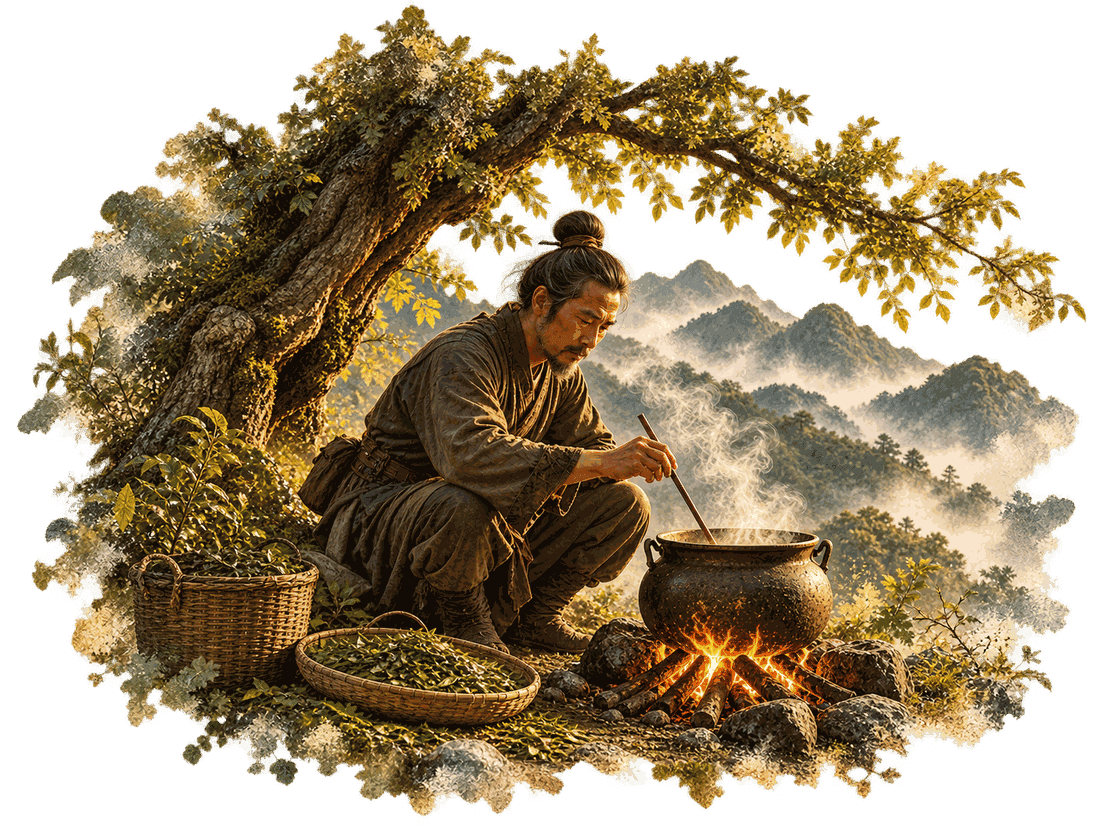
History lost the name of the first person to taste the wild leaf, so Chinese legend gave it one: Shennong, the Divine Farmer, one of the mythical rulers credited with teaching people to farm. He is said to have tasted hundreds of plants to learn which ones healed and which ones harmed.
The best-known version says a few leaves drifted from a wild tree into water he was boiling. That scene belongs to later retellings. The older claim is simpler: around 760, Lu Yu wrote in the Classic of Tea that tea as a drink began with Shennong.
Tradition places Shennong nearly five thousand years ago, far beyond any record. The legend is not history, but it keeps something the evidence supports: tea began in China as a plant people came to know by tasting it.
Nature First
Before it was anyone’s crop, tea was a wild tree of the mountains where China meets Myanmar and India.
Curious Minds
Its first users left no names. Knowledge of the leaf passed by taste and habit, not by writing.
The First Spark
Some 2,400 years ago, tea was already brewed in northern China, and later buried with an emperor.
A Journey Begins
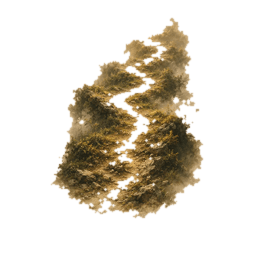
From Yunnan, the plant moved north and east across China: the first stage of a journey that would reach most of the world.
Every tea in the world comes from one plant —
and that plant comes from these mountains.
For most of its early history, tea was known by taste, not by record. When the records begin, they treat it not as a pleasure but as a remedy.
Every tea we pour at Camelia Lounge, from a Chinese green to an Assam black, comes from this one plant.
Why would anyone first drink something so bitter?
Next · Chapter TwoThe First Medicine